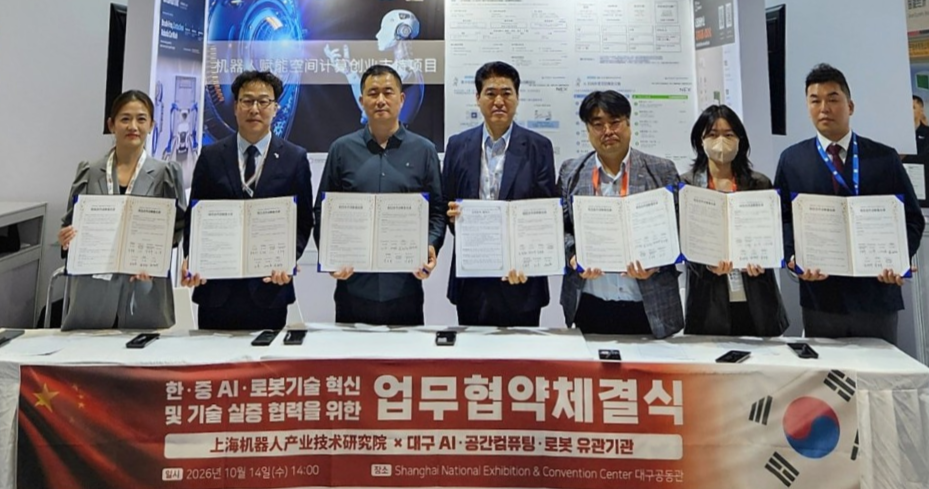
Daegu Technopark (Daegu TP) announced the signing of a Memorandum of Understanding (MOU) between seven Korean and Chinese organizations to strengthen cooperation in AI and robotics innovation and industrial development. The agreement was signed at the Daegu Joint Pavilion during the China International Industry Fair (CIIF 2026) in Shanghai, China. The participating organizations include the Shanghai Robotics Industry Technology Research Institute (SRI), Daegu Technopark, DRIPA, the Daegyeong ICT Industry Association, the Yeongnam Branch of the Korea IT Businesswomen’s Association, Kyungpook National University’s Institute for Information Technology Convergence, and the AI Utilization Support Project Group at Daegu Haany University.
The MOU aims to establish a practical framework for collaboration beyond technology exchange, connecting joint research and development (R&D) with technology commercialization and market entry. Key areas of cooperation include identifying joint Korea–China AI and robotics R&D projects, facilitating technology exchange between companies and research institutions, supporting field demonstrations and certification, expanding market access, organizing international seminars and forums, and promoting internships and personnel exchanges. Particular attention will be given to physical AI applications, including spatial perception, autonomous robotic manipulation, multi-robot fleet management, and the use of three-dimensional spatial data in manufacturing, logistics, and service industries.
The exhibition also highlighted emerging industrial trends, including edge AI for intelligent robotic decision-making and precision control, digital-twin-based management of multiple robots, and the creation of 3D spatial data for robot training using virtual reality (VR) and motion capture. Representatives of SRI expressed their commitment to expanding international cooperation between Daegu and Shanghai, particularly in joint research and overseas commercialization of physical AI and spatial computing technologies.
The participating Korean organizations also emphasized the importance of building international research networks that enable Daegu’s robotics and AI companies to validate their technologies, accelerate commercialization, and explore opportunities in the Chinese market. Following its signing, the organizations plan to identify specific areas of mutual interest, match companies with potential technology partners, explore joint research topics, exchange information on demonstrations and certification, and facilitate expert and personnel exchanges.
Daegu TP’s AI Spatial Computing Center, which led the initiative, stated that the agreement represents a practical starting point for connecting Daegu’s robotics ecosystem with Shanghai’s technology validation network. They will lead follow-up discussions with regional universities and industry partners to translate the agreement into tangible outcomes, including technological advancement and expanded overseas business opportunities. Through this initiative, Daegu aims to strengthen its international partnerships and create new opportunities for local startups and technology companies in the rapidly growing fields of AI, robotics, physical AI, and spatial computing.
Visit DAEGU TECHNOPARK


